Healthcare Financing and Sustainability

There is a mental health provider shortage in Arizona. One way to increase the number of providers in this space could be to provide tuition aid and tuition reimbursement for providers who choose to work in underserved areas and with vulnerable populations. In 2015, SB 1194 was signed into law (AACHC, n.d.). This increased the coverage for people who are eligible to apply to the Arizona State Loan Repayment Program. This program provides student loan repayment to primary care providers who agree to work in underserved areas in Arizona. Mental health providers eligible include “psychiatrists, psychologists, physician assistants, advanced practice registered nurses, clinical social workers, professional counselors, and marriage and family therapists” (AZDHS, n.d.). However, this program is limited to workers who will choose to work in non-profit organizations or rural private organizations.  More mental health care is needed for teens in schools.

This year, HB 2072, “Mental Health Professionals Academy,” was introduced to the AZ legislature to establish a pilot program at Northern Arizona University to help students pay for their mental health profession education (Legiscan, 2020). This program would provide scholarships for student’s education in preparation for a mental health profession who commits to working in corrections or in public schools (Legiscan, 2020). Unlike the student loan reimbursement opportunities, this would provide up-front coverage for the cost of the participant’s education, saving students from accruing interest during their education. This bill was passed in the House and is presently pending the Senate Appropriations Committee.

We have to increase the number of mental health professionals if we are going to decrease youth suicide and sustain this long term. Although we have some great programs, there are still limited funds for these. There are also many other types of behavioral health professionals that are not included in these programs who play a significant role in mental healthcare such as behavior coaches, psychiatric technicians, and case managers. These are very difficult positions that require educated, skilled professionals to be competent and successful. Many mental health professionals have low salaries and therefore jump around between organizations to get higher paying positions. Non-profit mental health organizations are already stretching their dollars and would benefit from more funding to pay their employees better wages that would help them stay longer. I have often heard frustration from adolescent patients who lament about losing their case manager or therapist because they no longer work at their clinic. Patients would benefit from this because they would be able to make stronger therapeutic alliances with their mental health care providers.

                                                  References                                                

Arizona Alliance for Community Health Centers (AACHC). (n.d.). Arizona student loan repayment program. Retrieved from https://www.aachc.org/arizona-student-loan-repayment-program/

Arizona Department of Health Services (AZDHS). (n.d.). Loan repayment program. Retrieved from https://www.azdhs.gov/prevention/health-systems-development/workforce-programs/loan-repayment/index.php#faqs

Legiscan. (2020). AZ HB2072, 2020, Fifty-fourth Legislature 2nd Regular. Retrieved from https://legiscan.com/AZ/bill/HB2072/2020

Blog 6: Technology Innovations and Implications

In my last blog, I wrote about the impact of the private sector including tele-medicine strategies and social media on youth suicide. This week I’d like to talk a little more about innovations in technology that have an impact on youth suicide as well as their implications for data and privacy.

Technology has been used more in mental health over the last two decades. There are apps for tracking mental health and new medications that use technology to show medication compliance.

I was able to listen to a presentation by a drug representative at one of my clinical sites last year for the drug Abilify MyCite. Abilify is used in children and adults. It is approved for children and adolescents for some disorders and used off label as well. Abilify is a medication approved for the treatment of schizophrenia and bipolar one disorder (FDA, 2017). Abilify MyCite was recently approved by the FDA and it is the first pill to have a sensor that can track the patient’s medication compliance by signaling to a wearable patch that the medication was ingested (FDA, 2017). The data collected can be transferred to a phone app and the patient can choose to allow their provider or family members to have access to the data. This is a great opportunity for patients who are court ordered to be able to show their compliance with medications. The patch also has the ability to track the patient’s activity level with a pedometer and the time spent resting using a sensor that can track whether the patient is lying down (AbilifyMyCite, 2020).  Within the app the patient can also track their mood, how well they rested and why they missed their pill, if applicable (AbilifyMyCite, 2020).

This is an innovative new technology that has many positive and negative implications. This would be a great way to help patients remember to take their medications and be more aware of their mood. This could help decrease suicide by increasing compliance and helping patients be aware of when they may need to schedule an appointment with their provider. When I first learned of this medication I wondered how this changes the provider’s liability if they have access to this information. If the provider has access to the information and can see that the patient is not taking their medication, is extra active, and not sleeping, are they ethically and legally responsible for reaching out to the patient? Or perhaps the patient is not taking the medication at all and they have been resting too often, could this be a sign that the patient’s mental health is deteriorating and should the provider send help?  Apps that track mood can be wonderful for patients. However, if providers have access to this information the amount of data would be overwhelming. Luckily, this medication and mood tracking apps are voluntary for patients so it is their choice to opt in to using them. Although, some are concerned that insurance companies may provide incentives for patients to use medications with sensors and that is too much like coercion to use the medication (Belluck, 2017). Parents may want their children to take this medication as a way to make sure they are being med compliant and this may feel like a breach of trust to the child. This may be just the beginning of this type of technology for medication tracking, so it is important to be aware of the ethical and legal implications so we are prepared for the future.

AbilifyMyCite. (2020). What is the ABILIFY MYCITE system? Retrieved from https://www.abilifymycite.com/about

Belluck, P. (2017). First digital pill approved to worries about biomedical ‘Big Brother.’ Retrieved from https://www.nytimes.com/2017/11/13/health/digital-pill-fda.html

FDA. (2017). FDA approve pill with sensor that digitally tracks if patients have ingested their medication. Retrieved from https://www.fda.gov/news-events/press-announcements/fda-approves-pill-sensor-digitally-tracks-if-patients-have-ingested-their-medication

Blog 5: Private Sector Innovation

The private sector plays an enormous role in healthcare. Many of the policies made by the public sector affect the services provided by the private sector (Longest, 2010). In Arizona, there are many different private organizations that influence mental health. Arizona has many private clinics, hospitals, and other organizations that provide direct patient care. One organization, Bayless Integrated Healthcare, provides care for both physical and mental health. They offer “Virtual Care” so patients can see their providers using their cell phones from anywhere they please (Bayless Integrated Healthcare, 2020). Flexible, innovative tele-health approaches like these can increase access to care and provide services to patients with minimal disruption to their lives. This is important for youth because they can have their behavioral health needs met without missing precious time at school.

As we know, social media plays a large role in daily life for youth and many people have written suicide notes on social media. Some studies are trying to understand the links between the internet and mental health including suicidality. Issues such as cyberbullying and harassment on social media negatively impact youth mental health and have been linked to youth suicide due to increasing feelings of isolation and hopelessness (Luxton, June, & Fairall, 2012). Although there are chat rooms where people can go for support with mental health issues, there are also chat rooms and platforms where people spread prosuicide information, such as ways for people to die by suicide.

Fortunately, some social media platforms are taking innovative approaches to solving this issue. Facebook has pages for the National Suicide Prevention Lifeline and the American Foundation of Suicide Prevention that share resources and information for suicide prevention (Luxton, June, & Fairall, 2012). Facebook began using artificial intelligence in 2017 to identify posts that signify suicidal ideations and then either send the user information about resources or the content moderators share this information with law enforcement (Goggin, 2019). Although this does open up some privacy concerns, this is intervention may lead to lives being saved. YouTube has many videos about suicide prevention that have been made by organizations and individuals (Luxton, June, & Fairall, 2012). Google’s search engine provides the National Suicide Prevention Lifeline whenever a search involves suicidal ideation or intent (Luxton, June, & Fairall, 2012). Interventions like these meet youth where they are at and provide direct suicide prevention strategies.

Other organizations are trying to use technology for suicide prevention, as well. Mobile apps for therapy and mood tracking have been created to predict and prevent suicidality, although research on their efficacy is still lacking (Vahabzadeh, Sahin, & Kalali, 2016). We know that youth suicide is a complex issue and it is great to see the innovative approaches that people are taking to tackle this issue from many different angles.

References

Bayless Integrated Healthcare. (2020). Virtual care. Retrieved from https://www.baylesshealthcare.com/virtual-care/

Goggin, B. (2019). Inside Facebook’s suicide algorithm: Here’s how the company uses artificial intelligence to predict your mental health state from your posts. Retrieved from https://www.businessinsider.com/facebook-is-using-ai-to-try-to-predict-if-youre-suicidal-2018-12

Longest, B.B. Jr. (2010). Health policymaking in the United States (5th ed.). Chicago, IL: Health Administration Press.

Luxton, D. D., June, J. D., & Fairall, J. M. (2012). Social media and suicide: a public health perspective. American journal of public health102(S2), S195-S200. Retrieved from https://www.ncbi.nlm.nih.gov/pmc/articles/PMC3477910/

Vahabzadeh, A., Sahin, N., & Kalali, A. (2016). Digital suicide prevention: can technology become a game-changer?. Innovations in clinical neuroscience13(5-6), 16. Retrieved from https://www.ncbi.nlm.nih.gov/pmc/articles/PMC5077254/

Blog 4: Influence of the Public Sector Institutions and Policies

The public sector has great influence on youth suicide in Arizona. The Arizona Health Care Cost Containment System (AHCCCS) is the Medicaid program for the state of Arizona. They provide medical and behavioral health care services for citizens in Arizona who qualify based on their income (AHCCCS, 2020). These services are funded by the federal and state government. AHCCCS plans cover behavioral health services including behavioral health day programs, crisis services, health promotion, residential behavioral health services, support services, and treatment services (AHCCCS, 2020). These services along with monitoring programs help them to achieve their suicide prevention goals outlined in their annual state plans that I wrote about my last blog. Many vulnerable children who are at risk for suicide are insured by AHCCCS, therefore the services and policies set forth by this institution have immense impact on their mental health and wellbeing,

Public schools are another institution that can have a huge impact on child and adolescent mental health. When I think back to my meeting and interview with Senator Rick Gray, I remember how he emphasized the importance of speaking to school boards about school and district policies. The public school system provides many opportunities to reach students, but they are governed by their school board.  Luckily, the public is able to participate in their meetings monthly. We know that the Mitch Warnock Act that requires school employees to get suicide prevention training will begin this year, but there are also other opportunities that schools have to promote mental health. There are school counselors and school nurses that are available for students to go to for resources. I looked at my local school districts and they have information about crisis hotlines and the national suicide prevention lifeline. However, from their websites it is not clear what other mental health programs or education they provide, if any. The Queen Creek Unified School District (QCUSD) has “raise awareness of mental health” as one of their priority areas listed on their website (QCUSD, 2020). One school in QCUSD lost five students to suicide in one year. These tragic, preventable deaths are a call to action for our community. According to a local journalist, QCUSD works with local community mental health organizations to conduct suicide prevention presentations for students and they have put the Teen Lifeline on the back of student ID cards (Dyer, 2019). These are positive first steps for suicide prevention and mental health promotion that can really make a difference in children’s lives.

County health departments and the justice system can also have an impact on youth suicide prevention. County health departments track children and teen suicides. They often have local clinics that provide health services and some partner with schools to provide services and education to members of the community. County websites provide education about local services in the community. In Mesa, AZ, the police department has a Crisis Intervention Team comprised of trained police officers and other employees that can assist citizens who are experiencing mental illnesses and crises (MesaAZ, 2020). With this team, the public is able to get assistance from properly trained state employees that can understand the needs of the person in crisis. Each of these services can make an impact on the youth suicide problem Arizona is facing.

References

Arizona Health Care Cost Containment System (AHCCCS). 2020. About Us. Retrieved from https://www.azahcccs.gov/AHCCCS/AboutUs/

Arizona Health Care Cost Containment System (AHCCCS). 2020. AHCCCS programs and covered services. Retrieved from https://www.azahcccs.gov/AHCCCS/AboutUs/programdescription.html

Dyer, Richard. (2019, October 25). Suicide-prevention efforts throughout East Valley. Apache Junction/Gold Canyon Independent. Retrieved from https://yourvalley.net/apache-junction-independent/stories/suicide-prevention-efforts-throughout-east-valley,109047

MesaAZ. (2020). Crisis intervention team. Retrieved from https://www.mesaaz.gov/residents/police/departments-divisions/crisis-intervention-team

Blog 3: The Historical and Contemporary Role of Institutions and Actors and the Statutory and Regulatory Mechanisms Related to Youth Suicide

There are various governmental and non-governmental institutions and actors that have influenced policy related to youth suicide. Actors can be governmental such as “the administration, civil servants, and Congress” and non-governmental such as “interest groups, academics, media, and public opinion” (Kingdon, 2011, p. 21). Youth suicide is a problem that can be addressed by statutory and regulatory mechanisms on many different levels. Although there have been significant strides taken in the last century towards suicide prevention there are still many gaps and problems. As a future Nurse Practitioner, it will be important for me to understand the current laws related to mental health so I know what can be done in the future.

The United States started the first suicide prevention center in 1958 funded by the U.S. Public Health Service (U.S. Department of Health and Human Services (HHS) Office of the Surgeon General and National Action Alliance for Suicide Prevention, 2012). Then, the National Institute of Mental Health (NIMH) created a task force in Arizona to determine priorities and actions for suicide prevention in the US and the findings were reported in 1973 (U.S. Department of Health and Human Services Office of the Surgeon General and National Action Alliance for Suicide Prevention, 2012). After the Centers for Disease Control and Prevention (CDC) found that youth suicide was increasing, HHS created a new Task Force on Youth Suicide in 1989 (U.S. Department of Health and Human Services Office of the Surgeon General and National Action Alliance for Suicide Prevention, 2012). Also on the federal level, the Garrett Lee Smith Memorial Act (GLSMA) created a federal grant program for youth suicide prevention that provides funding to colleges and universities for prevention efforts (U.S. Department of Health and Human Services Office of the Surgeon General and National Action Alliance for Suicide Prevention, 2012). Although there is a National Suicide Prevention Lifeline (1-800-273-8255) that provides 24/7 support from crisis centers across the US, there has recently been a proposal to change the phone number to 988, a shorter number that would be easier to remember in a crisis (Federal Communications Commission, 2019).

In my previous blogs, I wrote about some of the specific changes happening in Arizona. The Mitch Warnock Act requiring school employees to get suicide prevention training who work with children from grades 6-12 will begin in the 2020-2021 school year (Office of the Governor, Doug Ducey, 2019). This statute set forth by the Governor requires regulations from school boards in order to be successful. Additionally, the Arizona Health Care Cost Containment System (AHCCCS) and the Arizona Suicide Prevention Coalition have annual state plans that provide recommendations, objectives, and strategies for suicide prevention in Arizona (Arizona Coalition for Suicide Prevention and AHCCCS, 2019). Youth suicide prevention is a huge issue right now and has been receiving more and more media attention due to the recent frightening statistics. There have been numerous bills related to suicide and mental health that have been introduced to the Arizona State Legislature this year.

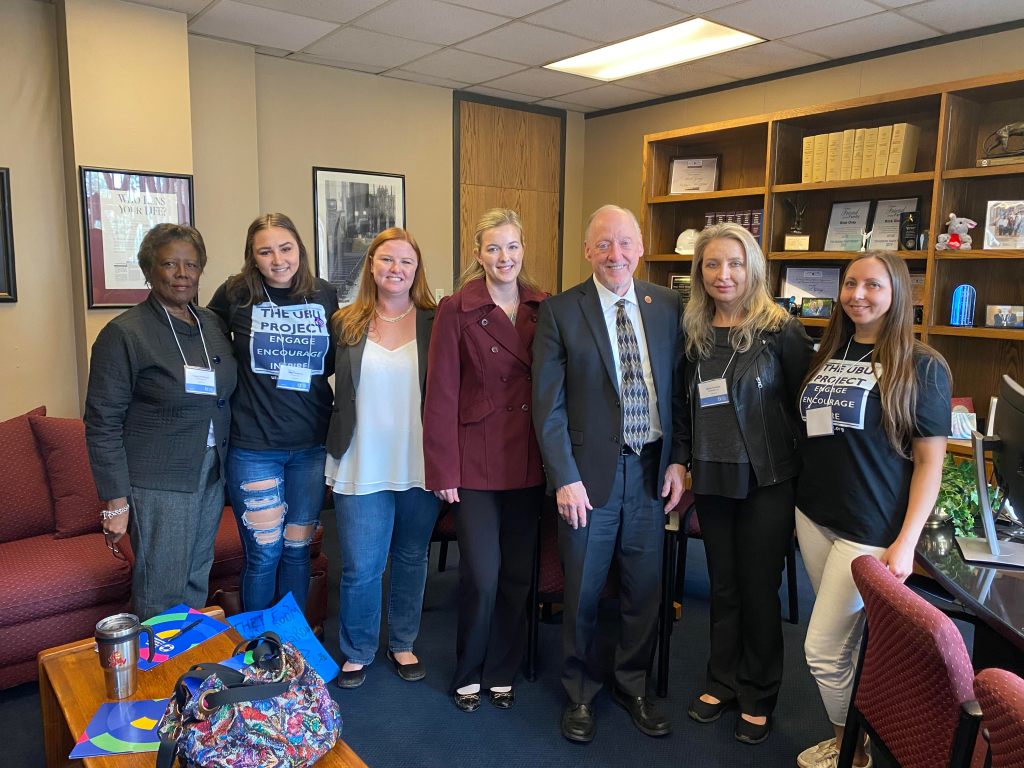
On February 3rd, I participated in the American Foundation for Suicide Prevention Day at the Capitol in Arizona. I was able to sit down with a few legislators and fellow advocates to talk about a few new bills, including Jake’s Law. I had the privilege of speaking with Senator Rick Gray about Jake’s Law (SB1523) and the problem of youth suicide. Senator Gray spoke about the importance of community and connections between one another for mental health. He commended a young student for being brave and sharing their story in the meeting. He also talked about the importance of youth being open and transparent about how they are feeling with their peers which can give other peers hope. When we spoke to him about teens and mental health, he recommended that we also speak with school boards to address specific issues in school because they set district wide policies. It was great to be able to sit down with a lawmaker and hear his thoughts on mental health. Legislators are so busy during this time of year and it was great to see how open they were to hearing what we had to say and providing recommendations.

Senator Gray and fellow suicide prevention advocates

I also had the privilege of meeting and speaking with Ben and Denise Denslow, the parents of Jacob Edward Machovsky, who passed away in 2016. Ben and Denise lost their son to suicide and this moved them to working with Senator Brophy McGee and Representative Weninger to create and introduce Jake’s Law. They don’t want any other families to go through what they did, so they are hoping to pass Jake’s Law and get increased mental health services to Arizonans. Ben spoke to me about his experience creating the bills and navigating the political arena. It was amazing to meet them and hear their story.

Ben and Denise Denslow, Myself, and fellow DNP student Natalia

References

Arizona Coalition for Suicide Prevention and Arizona Health Care Cost Containment System. (2019). An end to suicide in Arizona 2019 state plan. Retrieved from https://tst.azahcccs.gov/AHCCCS/Downloads/2019StatePlantoEndSuicide.pdf

Federal Communications Commission. (2019). FCC proposes 988 for suicide prevention and mental health hotline. Retrieved from https://www.fcc.gov/document/fcc-proposes-988-suicide-prevention-mental-health-hotline

Kingdon, J. W. (2011). Agendas, alternatives, and public policies (2nd ed.). Boston, MA: Longman.

Office of the Governor, Doug Ducey. (2019, May 8). Governor Ducey signs bill combating teen suicide [Press release]. Retrieved from https://azgovernor.gov/governor/news/2019/05/governer-ducey-signs-bill-combating-teen-suicide

U.S. Department of Health and Human Services (HHS) Office of the Surgeon General and National Action Alliance for Suicide Prevention. 2012 National Strategy for Suicide Prevention: Goals and Objectives for Action. Washington, DC: HHS, September 2012. Retrieved from https://www.ncbi.nlm.nih.gov/books/NBK109918/

Blog 2: Ethical Impact of Healthcare Policy and Role of Ethics in Policy Decision-Making Related to Youth Suicide

Suicide is clearly an important health issue in Arizona, especially for our youth. In 2020, there have already been new bills introduced to the Arizona State legislature that address child suicide prevention and mental health care. “Jake’s Law,” introduced last week, aims to increase behavioral health services, create a suicide mortality review team, and enforce federal parity laws (Whaley, 2020). It is important that we are aware of the role ethics plays in health policy as we review these bills decide which ones to advocate for or against.

I remember taking my undergraduate nursing ethics class, reading the Code of Ethics for Nurses with Interpretive Statements (American Nurses Association [ANA], 2015), and making note-cards about all the principles of ethics in nursing. Back then, I focused on how these principles would affect my day-to-day bedside nursing practice. Now, as a doctoral nursing student, I have the opportunity to see how nurses are called to be involved in policy. As Provision 7.3 of our code of ethics states, nurses are responsible for contributing to policy development on all levels of healthcare (ANA, 2015). We have a duty to participate in the political arena by leading, mentoring, advocating, and even serving as representatives to ensure that healthcare policies are ethical, evidence-based, and effective (ANA, 2015).

Thankfully, we live under a government where the people can create policy and get policy enacted. Therefore, the ethics of a public policy and the policymaking process is related to the ethics of the people making the policy decisions (Longest, 2010). Policy makers must consider the ethical impact of a new policy with regards to the four ethical principles that guide policy making: autonomy, justice, beneficence, and nonmaleficence (Longest, 2010). (These are all ethical principles of nursing, too!) They must understand how it will affect autonomy, the concept that relates to an individual’s right to make their own decisions. In order to adhere to this principle, the policymaking process must be truthful and honor privacy (Longest, 2010). Policy must be sure to adhere to the principle of justice; the principle related the fairness (Longest, 2010). Fairness can be subjective, so there are different ethical perspectives that can guide this. Additionally, policymaking is to uphold beneficence. Beneficence is the principle that relates to doing good and providing the least amount of burden (Longest, 2010). Lastly, Longest (2010) describes nonmaleficence as the principle “to do no harm” (p. 208). Policymakers must be cognizant of the possibility that some policies may have negative effects.

With these principles in mind, one can begin to discuss how ethical principles relate to policymaking to help with suicide prevention.  We know that policy must respect the rights of the people, be fair, and do the most good while doing no harm.

There has been significant debate over the ethics related to suicide. One may argue that it is a person’s right to decide to take their own life. But, when a person is in crisis their decision-making capacity is impaired, and therefore it is not just to allow someone to take their own life, especially because evidence shows that the majority of people who complete suicide have a mental illness (Kelly & Dale, 2011). Many suicide prevention measures impede on one’s rights in order to ensure that they have the opportunity to receive treatment. When a person reports having thoughts to harm themselves, confidentiality can be breached, their belongings can be taken away (i.e. weapons), and they can be forced to get treatments. These measures must be taken in order to give them the opportunity to obtain their decision-making capacity and to be non-suicidal again.

The Arizona Child Fatality Review Program (2019) team has decided that ALL child deaths by suicide are preventable. Therefore, there is a need for interventions to prevent child suicide. In addition to actual mental health services and treatment in community and hospital settings, there is a call to address the social determinants of health related to suicide (Fitzpatrick, 2018). There are numerous opportunities for policymakers to make a positive impact on suicide prevention in a way that adheres to the ethical principles discussed.

 “Jake’s Law” (SB1523 and HB2764) introduced to Arizona’s legislature by Sen. Kate Brophy McGee and Rep. Jeff Weninger, includes these provisions:

  • “Requires insurance cards issued in Arizona to clearly identify which governmental agency to contact for questions or to file complaints.
  • Requires the Department of Insurance to establish a consumer-friendly webpage containing resources pertaining to mental health parity, a step-by-step guide on how to file parity violation complaints, and a summary regarding insurers’ compliance with mental health parity laws.
  • Prohibits an insurer from denying a claim for mental health or substance abuse benefits based solely on the grounds that the service was provided in an educational setting or was court ordered.
  • Establishes a Mental Health Parity Advisory Committee to provide the Director of the Department of Insurance advice on case management, discharge planning, and expedited review and appeals processes for cases involving suicidal ideation.
  • Expands access to behavioral health services in schools be establishing an $8 million fund to help students covered by private insurance but who are unable to afford their copay or deductible.
  • Establishes and appropriates $100,000 for a Suicide Mortality Review Team within the Department of Health Services. (Whaley, 2020)”

From an ethical stand point, these laws could increase individual’s autonomy by allowing them better access to the care that they need. The provisions adhere to the principle of justice by making the insurance companies comply with existing federal parity laws. And they can do good for the people of Arizona by providing more treatment and resources to youth with mental health issues. However, it may cause a burden by increasing premiums for insurance payers and taxpayers. What other ethical implications of these provisions do you see?

It will be interesting to see how these bills progress and I look forward to discussing other new bills that have been introduced to the Arizona State legislature this year in future blogs.

References

American Nurses Association (2015). Code of ethics for nurses with interpretive statements. Silver Spring, MD: Nursesbooks.org Retrieved from https://www.nursingworld.org/coe-view-only

Arizona Child Fatality Review Program (2019). Arizona child fatality review program: Twenty-sixth annual report. Retrieved from https://www.azdhs.gov/documents/prevention/womens-childrens-health/reports-fact-sheets/child-fatality-review-annual-reports/cfr-annual-report-2019.pdf

Fitzpatrick, S. J. (2018). Reshaping the ethics of suicide prevention: Responsibility, inequality, and action of the social determinants of suicide. Public Health Ethics, 11(2), 179-190. https://doi-org.ezproxy1.lib.asu.edu/10.1093/phe/phx022

Kelly, C., & Dale, E. (2011). Ethical perspectives on suicide and suicide prevention. Advances in Psychiatric Treatment, 17(3), 214-219. doi: 10.1192/apt.bp.109.007021

Longest, B.B. Jr. (2010). Health policymaking in the United States (5th ed.). Chicago, IL: Health Administration Press.

Whaley, M. (2020). New Arizona measure tackles suicide, mental health. Retrieved from https://stateofreform.com/featured/2020/02/new-arizona-measure-tackles-suicide-mental-health/

Blog 1: Overview of Child Suicide in Arizona

Imagine a time when children in Arizona are able to get their mental health care needs met in a timely manner. A time when at-risk children are quickly identified and effective interventions are implemented. Now, imagine that the children in Arizona had the lowest rates of suicide in the country. This time in Arizona will never come if the child and adolescent suicide rate is not addressed.

I have chosen to address the topic of child suicide in Arizona in this blog because I have been personally and professionally affected by this rising issue. I lost someone very close to me to suicide and I want to do everything that I can to help those suffering from mental illness and thoughts of suicide in any way that I can. This loss is part of the reason I pursued a career in nursing and mental health. As a future doctorally prepared psychiatric mental health nurse practitioner, I am choosing to use every avenue that I can to combat this issue in my home state.

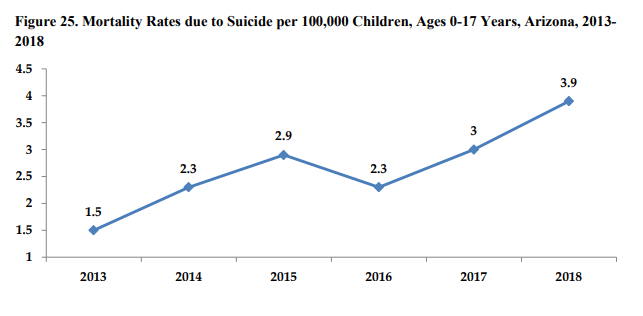
Over the last three years, the teen suicide rate in Arizona has increased by 25%(America’s Health Rankings United Health Foundation, 2019). According to the Arizona Child Fatality Review Program (2019), the child (ages 0-17) suicide rate increased 28% in 2018 and the mortality rate due to suicide has increased significantly over the last 6 years (see Figure 1). However, the review team determined that ALL deaths by suicide are preventable. In Arizona, suicide is the “2nd leading cause of death for ages 15-34” (American Foundation for Suicide Prevention, 2019).  As a registered nurse working on an inpatient child and adolescent behavioral health unit for the last four years, I have seen the personal, familial, and community effects of suicidality in youth. Fortunately, the patients I serve have been given another chance to receive care and combat their illnesses. But, as you can see, many children have not been given this chance.

Figure 1. Rise in mortality rates due to suicide per 100,000 children (ages 0-17) in Arizona from 2013-2018. Adapted from “Arizona Child Fatality Review Program: Twenty-Sixth Annual Report,” by Arizona Child Fatality Review Program, 2019, p.48. Retrieved from https://www.azdhs.gov/documents/prevention/womens-childrens-health/reports-fact-sheets/child-fatality-review-annual-reports/cfr-annual-report-2019.pdf

There are many risk factors for suicide in children and adolescents. The Arizona Child Fatality Review Program (2019, p. 48) made these risk factors clear:

“Behavioral health issues and disorders, particularly mood disorders, depressant and anxiety disorders

 Substance use and abuse

Impulsive and/or aggressive tendencies

History of trauma or abuse

Major physical illnesses

Family history of suicide and previous suicide attempts

Easy access to lethal means

Lack of social support and a sense of isolation

Stigma associated with asking for help

Lack of access to health care, especially mental health and substance abuse treatment”

With these risk factors in mind, there are many opportunities for policies that can impact child and adolescent mental health. This fatality report has provided robust evidence of the issues of child suicide in Arizona and even offered recommendations for policy makers. In 2019, Governor Doug Ducey signed the Mitch Warnock Act, SB 1468, that requires Arizona school employees for grades 6-12 to get formal suicide prevention training at least every three years(Office of the Governor, Doug Ducey, 2019). Schools have already begun preparing for education training because this requirement starts in the 2020-2021 school year. For the FY 2021 budget, Governor Ducey has proposed “$400,000 to establish a Suicide Mortality Review Team to reduce suicide rates and target high-risk populations” (Office of the Governor, Doug Ducey, 2020).

 Arizona is off to a good start and it is clear that this issue will need to be tackled from multiple angles. There are local organizations that are dedicated to combating this issue in Arizona such as the American Foundation for Suicide Prevention who is holding their Arizona Advocacy Day this February to advocate for further Arizona policy changes that can improve mental health care and suicide prevention efforts(American Foundation for Suicide Prevention, 2020). I am hopeful for Arizona’s future and determined to explore this issue from a policy stand point with you all over the next few months.

References

American Foundation for Suicide Prevention (AFSP). (2020). Rally to prevent suicide in Arizona and state capitol day 2020. Retrieved from https://afsp.org/event/rally-to-prevent-suicide-in-arizona-state-capitol-day-2020/

American Foundation for Suicide Prevention (AFSP). (2019). Suicide facts and figures: Arizona 2019. Retrieved from https://afsp.org/about-suicide/state-fact-sheets/#Arizona

America’s Health Rankings United Health Foundation (AHRUHF). (2019). Teen suicide in Arizona. Retrieved from https://www.americashealthrankings.org/explore/health-of-women-and-children/measure/teen_suicide/state/AZ

Arizona Child Fatality Review Program (2019). Arizona child fatality review program: Twenty-sixth annual report. Retrieved from https://www.azdhs.gov/documents/prevention/womens-childrens-health/reports-fact-sheets/child-fatality-review-annual-reports/cfr-annual-report-2019.pdf

Office of the Governor, Doug Ducey. (2020, January 17). Governor Ducey releases fiscally responsible, balanced executive budget [Press release]. Retrieved from https://azgovernor.gov/governor/news/2019/05/governer-ducey-signs-bill-combating-teen-suicide       

Office of the Governor, Doug Ducey. (2019, May 8). Governor Ducey signs bill combating teen suicide [Press release]. Retrieved from https://azgovernor.gov/governor/news/2019/05/governer-ducey-signs-bill-combating-teen-suicide

Design a site like this with WordPress.com
Get started