Imagine a time when children in Arizona are able to get their mental health care needs met in a timely manner. A time when at-risk children are quickly identified and effective interventions are implemented. Now, imagine that the children in Arizona had the lowest rates of suicide in the country. This time in Arizona will never come if the child and adolescent suicide rate is not addressed.
I have chosen to address the topic of child suicide in Arizona in this blog because I have been personally and professionally affected by this rising issue. I lost someone very close to me to suicide and I want to do everything that I can to help those suffering from mental illness and thoughts of suicide in any way that I can. This loss is part of the reason I pursued a career in nursing and mental health. As a future doctorally prepared psychiatric mental health nurse practitioner, I am choosing to use every avenue that I can to combat this issue in my home state.
Over the last three years, the teen suicide rate in Arizona has increased by 25%(America’s Health Rankings United Health Foundation, 2019). According to the Arizona Child Fatality Review Program (2019), the child (ages 0-17) suicide rate increased 28% in 2018 and the mortality rate due to suicide has increased significantly over the last 6 years (see Figure 1). However, the review team determined that ALL deaths by suicide are preventable. In Arizona, suicide is the “2nd leading cause of death for ages 15-34” (American Foundation for Suicide Prevention, 2019). As a registered nurse working on an inpatient child and adolescent behavioral health unit for the last four years, I have seen the personal, familial, and community effects of suicidality in youth. Fortunately, the patients I serve have been given another chance to receive care and combat their illnesses. But, as you can see, many children have not been given this chance.
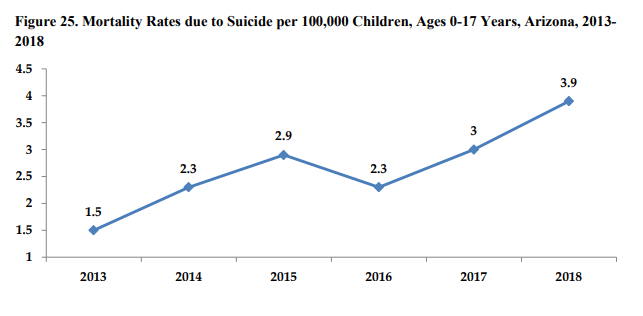
Figure 1. Rise in mortality rates due to suicide per 100,000 children (ages 0-17) in Arizona from 2013-2018. Adapted from “Arizona Child Fatality Review Program: Twenty-Sixth Annual Report,” by Arizona Child Fatality Review Program, 2019, p.48. Retrieved from https://www.azdhs.gov/documents/prevention/womens-childrens-health/reports-fact-sheets/child-fatality-review-annual-reports/cfr-annual-report-2019.pdf
There are many risk factors for suicide in children and adolescents. The Arizona Child Fatality Review Program (2019, p. 48) made these risk factors clear:
“Behavioral health issues and disorders, particularly mood disorders, depressant and anxiety disorders
Substance use and abuse
Impulsive and/or aggressive tendencies
History of trauma or abuse
Major physical illnesses
Family history of suicide and previous suicide attempts
Easy access to lethal means
Lack of social support and a sense of isolation
Stigma associated with asking for help
Lack of access to health care, especially mental health and substance abuse treatment”
With these risk factors in mind, there are many opportunities for policies that can impact child and adolescent mental health. This fatality report has provided robust evidence of the issues of child suicide in Arizona and even offered recommendations for policy makers. In 2019, Governor Doug Ducey signed the Mitch Warnock Act, SB 1468, that requires Arizona school employees for grades 6-12 to get formal suicide prevention training at least every three years(Office of the Governor, Doug Ducey, 2019). Schools have already begun preparing for education training because this requirement starts in the 2020-2021 school year. For the FY 2021 budget, Governor Ducey has proposed “$400,000 to establish a Suicide Mortality Review Team to reduce suicide rates and target high-risk populations” (Office of the Governor, Doug Ducey, 2020).
Arizona is off to a good start and it is clear that this issue will need to be tackled from multiple angles. There are local organizations that are dedicated to combating this issue in Arizona such as the American Foundation for Suicide Prevention who is holding their Arizona Advocacy Day this February to advocate for further Arizona policy changes that can improve mental health care and suicide prevention efforts(American Foundation for Suicide Prevention, 2020). I am hopeful for Arizona’s future and determined to explore this issue from a policy stand point with you all over the next few months.
References
American Foundation for Suicide Prevention (AFSP). (2020). Rally to prevent suicide in Arizona and state capitol day 2020. Retrieved from https://afsp.org/event/rally-to-prevent-suicide-in-arizona-state-capitol-day-2020/
American Foundation for Suicide Prevention (AFSP). (2019). Suicide facts and figures: Arizona 2019. Retrieved from https://afsp.org/about-suicide/state-fact-sheets/#Arizona
America’s Health Rankings United Health Foundation (AHRUHF). (2019). Teen suicide in Arizona. Retrieved from https://www.americashealthrankings.org/explore/health-of-women-and-children/measure/teen_suicide/state/AZ
Arizona Child Fatality Review Program (2019). Arizona child fatality review program: Twenty-sixth annual report. Retrieved from https://www.azdhs.gov/documents/prevention/womens-childrens-health/reports-fact-sheets/child-fatality-review-annual-reports/cfr-annual-report-2019.pdf
Office of the Governor, Doug Ducey. (2020, January 17). Governor Ducey releases fiscally responsible, balanced executive budget [Press release]. Retrieved from https://azgovernor.gov/governor/news/2019/05/governer-ducey-signs-bill-combating-teen-suicide
Office of the Governor, Doug Ducey. (2019, May 8). Governor Ducey signs bill combating teen suicide [Press release]. Retrieved from https://azgovernor.gov/governor/news/2019/05/governer-ducey-signs-bill-combating-teen-suicide
 Child and Adolescent Suicide in Arizona
“liked”
LikeLike
It is encouraging to learn about the current policies and initiatives in Arizona that are being pursued to address the tragic prevalence of child suicide locally. In development of these policies, I am interested in learning about initiatives in other states that have been effective in the past or currently that would be applicable to Arizona.
Some of the significant risk factors that the Arizona Child Fatality Review Program identified for child suicide you have reported includes lack of access to health care, stigma, access to lethal means, and substance abuse. Specific to those risk factors, a review of the status of Arizona’s health policies on access to care, stigma, gun laws, and substance abuse that has been identified by the Arizona Child Fatality Review Program could provide further insight into the prevalence.
The status of the mental health care system resource availability for children in Arizona is concerning. In the United States, other states must have found solutions to the barriers for mental health care system resources for children, or alternatively may not have similar factors within their state that present barriers in Arizona.
In addition to addressing risk factors and collaborating with expertise from other successful initiatives that have been implemented in other states with lower child suicide rates, I am also curious to learn more about data specific to the cause in increases in suicide rates. You have provided great data about the increase statistical trend in Arizona and I am interested in learning about the cause of the increase in the trend, such as what factors are correlated with the increase.
LikeLike